
Code of Behaviour
1. Introductory Statement
This Code of Behaviour sets out the policy, programmes, practices and procedures that together form Scoil Mhuire’s plan for helping our pupils to behave well and learn well. It is prepared in compliance with our obligations under Section 23 of the Education (Welfare) Act 2000, in accordance with Developing a Code of Behaviour: Guidelines for Schools (NEWB, 2008) and Bí Cineálta Procedures to Prevent and Address Bullying Behaviour for Primary and Post Primary Schools June (2024).
The Code of Behaviour addresses:
- The standards of behaviour expected in our school
- Our plan for promoting good behaviour
- The ways in which we respond to inappropriate behaviour
- The plan for implementing our Code of Behaviour
- School procedures for the use of suspension and expulsion.
2. Relationship to the Characteristic Spirit of the School
Scoil Mhuire is a caring school and we recognise the importance of building quality relationships of trust between our staff and pupils. We strive to ensure that all members of our school community live and work together in a supportive way, where each member feels happy, safe and secure. We endeavour to promote positive pupil behaviour and self-discipline, by setting high expectations, affirming good behaviour and ensuring fairness and equity. We recognise the differences between pupils and the need to accommodate these differences, while also balancing this need with the educational needs of other pupils in our school. We work consistently to provide an orderly and harmonious learning environment in which our pupils can make progress in all aspects of their development and become positive, responsible and increasingly independent members of our school community.
3. Aims
The aims of this Code of Behaviour are to:
- Create a climate that encourages and reinforces good behaviour
- Create a positive and safe environment for teaching and learning
- Encourage pupils to take personal responsibility for their learning and their behaviour
- Help our pupils to mature into responsible participating citizens
- Build positive relationships of mutual respect and mutual support among pupils, staff and parents/guardians
- Ensure that the school’s high expectations for the behaviour of all the members of the school community are widely known and understood.

4. Standard of Behaviour Expected in Scoil Mhuire
The standard of behaviour expected in our school reflects our core values, namely:
- Respect for self and others
- Inclusion, kindness, fairness and willingness to help others
- Courtesy and good manners
- Openness to the views and perspectives of others
- Readiness to use respectful ways of resolving difficulties and conflicts, and showing forgiveness.
Behaviours that are not acceptable in Scoil Mhuire include:
- Behaviour that is hurtful, including bullying, harassment, discrimination and victimisation
- Behaviour that interferes with teaching and learning
- Threats or physical hurt to another person
- Damage to property and theft.
4.1 Our School and Classroom Expectations
Our school and classroom expectations describe how pupils are expected to behave in Scoil Mhuire, in order to learn well and to develop into mature and responsible individuals.
4.1.1 School Expectations
As a pupil of Scoil Mhuire, I am expected to:
- Respect myself, my schoolmates and the adults who work in my school
- Be gentle and show forgiveness
- Be inclusive of other pupils in games and activities
- Be mannerly and use “Excuse me”, “Please” and “Thank you”, if speaking to/ interrupting an adult or entering another classroom
- Wear full school uniform*
- Arrive to school on time- teaching begins at 8.50am
- Follow the Classroom Rules
- Respect and care for school property and the school environment
- Walk in school corridors at all times
- Line up safely inside and on yard
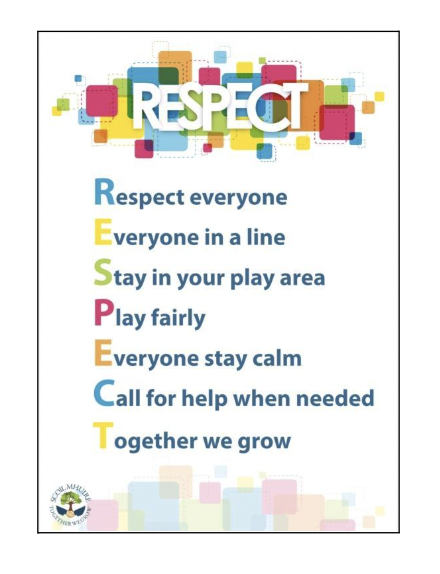
- Honour yard expectations as summarised in Scoil Mhuire’s RESPECT Code below.
- Refrain from directing inappropriate language towards others
- Should a conflict arise, inform an adult, ask for help to resolve it together or “Stop, Think and Walk Away”
- Show respect by remaining seated and listening at the Assembly.

* Scoil Mhuire’s school uniform consists of a half zip, blue polo shirt and navy tracksuit bottoms. Pupils may wear ear-studs. Other piercings are not advised for health and safety reasons, taping will be required. In summer knee length navy shorts are permitted.
4.1.2 Classroom Expectations
As a Scoil Mhuire pupil, in my classroom I am expected to:
- Respect myself, my classmates and the adults who work in my classroom
- Be kind and willing to help others
- Work to the best of my ability and take part in activities as best I can
- Listen to my teacher(s) and act on their instructions and advice
- Listen to my peers and show respect for their comments and contributions
- Be responsible for my work and my property
- Celebrate and be proud of all I do
- Use an inside voice at all times
- Respect classroom property and the property of my fellow pupils
- Walk within the classroom
- Keep my water bottle in my bag
- Go to the toilet one at a time
- Complete my homework to the best of my ability
- Remain with my class group at all times, unless assigned to another task or activity
- Take my lunch packaging and leftovers home each day
- Check the floor and windows at hometime
This list is not exhaustive and may be added to by the class teacher
4.2 Home School Agreement to Promote Positive Pupil Behaviour
Scoil Mhuire recognises the importance of building positive relationships of mutual respect and mutual support between staff and parents/guardians. As a school we also recognise how important it is that our parents/guardians understand and appreciate the rationale and expectations of our Code of Behaviour. Parental/guardian understanding and support are central to ensuring positive pupil behaviour and effective learning at school.
On entry to Scoil Mhuire, the following Home School Agreement is explained to and discussed with parents/guardians and they are provided with a copy of the agreement.
|
Home School Agreement |
|
As a school we will:
|
As parents/guardians we will:
|
5. Scoil Mhuire’s Plan for Promoting Good Behaviour
Promoting good behaviour is the main goal of our Code of Behaviour. This goal is achieved through the implementation of the multi-strategy approach detailed below.
5.1 Relationships between Teachers, SNAs & Pupils
As a school, we recognise that the quality of relationships between our teachers, SNAs and pupils is one of the most powerful influences on pupil behaviour. For many of our pupils, their school adults are a major source of support, empathy and pastoral care, and are hugely significant figures in their lives. As adults and professionals, we recognise that our teachers and SNAs have a strong capacity to develop good relationships with our pupils, and a greater responsibility for that relationship. To this end, our teachers and SNAs consistently promote mutually respectful relationships that balance warmth and empathy with objectivity, professional detachment, fairness and consistency.
5.2 Whole-school Strategies to Affirm and Promote Good Behaviour
The following strategies, to promote good behaviour at school level, are used consistently across the staff team:
- Engaging in positive everyday interactions with teachers, SNAs and pupils, showing that we care for our pupils’ safety and happiness
- Providing consistent school and class routines
- Creating clear boundaries and rules for all pupils
- Recognising and giving positive feedback around behaviour
- Helping pupils to recognise and affirm good learning behaviour
- Remaining flexible in supporting pupil’s behavioural and learning needs
- Exploring with pupils how we should all treat each other
- Listening to pupils when they are finding something difficult to understand
- Public and private expressions of affirmation and congratulations to pupils
- Provide a broad and balanced curriculum
5.3 Classroom Strategies to Affirm and Promote Good Behaviour
The following strategies, to promote good behaviour in individual classrooms, are used consistently by the teaching team:
- Understanding that there is a duty of care towards all pupils, that all pupils have rights and that their best interests come first
- Displaying and discussing clear classroom routines, school rules/agreements and clearly defined consequences (i.e. expected behaviour)
- Involving pupils in the preparation of school and classroom expectations and rules
- Displaying pupils’ work in classrooms and circulation areas
- Awarding Dojo points, affirming stickers, stamps or badges for the achievement of particular goals
- Providing Golden Time and additional time for an activity of the pupils’ choosing, e.g. physical activity, baking, digital technologies etc., when Classroom and School Rules are adhered to
- Sending a note of commendation to the child’s parent/guardian
- Arranging a visit to the Principal, Deputy Principal or other teacher for recognition of improved behaviour, act of kindness etc.
- Celebrating pupil achievements at school assemblies
- Presenting achievement certificates and trophies at classroom and school level
- Posting of congratulatory messages in the school newsletter, school website, Facebook page and Twitter account.
- Writing affirming comments on pupils’ work
- Teaching and regularly revising the RESPECT code, for behaviour on yard Teaching, through SPHE, how to treat yourself and others well
- Consistently following-up on behavioural incidences with or between pupils
- Remaining reasonable and proportionate when considering consequences
- Considering the risk of doing something versus the risk of doing nothing
- Why does this behaviour/incident matter?
- What is the primary behaviour?
5.3 Our Whole School Reward System
Our whole school reward system was majorly revamped and launched formally at school assemblies in January 2020, following extensive consultation with pupils, parents/guardians and staff. The reward system consists of the following elements:
- Class Dojo, an online behaviour management system that fosters positive pupil behaviours and classroom culture, is being implemented in each classroom. Our pupils earn individual and class Dojo Points based on classroom and school conduct.
- Dojo Points are awarded for the display of behaviours that we are encouraging as a school and that are in line with our behaviour values, standards, and expectations. They include:
- Demonstrating kindness
- Being inclusive
- Showing respect
- Being responsible
- Politeness and good manners
- Being a good sport
- Making a very good effort at a task
- Working diligently
- Lining up nicely
- Significant improvement in a desired area
- Goal of the assembly certificate for that period.
- Dojo Points can be awarded by class teachers, special education teachers, SNAs and school management.
- The new whole school reward system also includes a reward for the Class of the Month, to formally acknowledge the shared effort and endeavour of the class team to display positive behaviour. At the end of the month, the class that has accumulated the most Dojo Points will win a prize for the entire class. Prize options include a pizza party, popcorn party, a movie and hot chocolate party, and these choices will be added to and updated in response to feedback from pupils, staff and parents/guardians.
5.4 Restorative Practice
Scoil Mhuire is a Restorative Practice school and restorative practices form a core part of strengthening our pupils’ connection to both staff and their fellow pupils, promoting a positive school community, positive behaviour management and effective conflict resolution. As a school, following extensive staff professional development, we introduced Restorative Practice formally on a schoolwide basis in September 2017.
Our consistent schoolwide implementation of Restorative Practice enhances peer communication, involves our pupils directly in decision making and solution finding, and reduces formal disciplinary proceedings. Through the use of our Restorative Practice questions, detailed below, we build our pupils’ understanding of affective language and concepts. The questions focus on the incident of wrongdoing or conflict and allow the pupil to think about how their actions affect others. In so doing, it encourages pupil empathy, accountability, expression of feelings and thoughts, and problem solving, as well as taking responsibility for their behaviour by thinking through the causes and consequences.

Rolfe Reflective Model
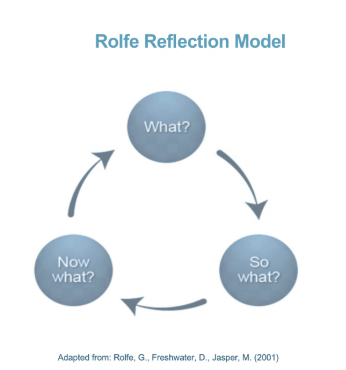
Rolfe Reflective Model of Rolfe et al. (2001) from Oide promotes a series of questions to enhance thinking by breaking down the key elements of a situation or occurrence to gain a deeper understanding of them.
| What:
• is the issue/problem? • was my role in the developing situation being reflected upon? • was I trying to achieve? • actions were being done towards the achievement? • were the responses of other people? • were the consequences for the learner/s? • were the consequences for me? • were the consequences for other people? • feelings were provoked in the student/s? • was positive about the experience? • was negative about the experience? • could be improved? |
||
| So what:
• is important about this? • more do I need to know about this? • other approaches might I have tried? • might I have done differently? • have I learned because of this? •issues have been brought to light by this situation? |
||
| Now what:
• could I do? • do I need to do? • should I ask of others to support me? • do I need to avoid in future? • have I learned? • will I recognise in advance? • broader issues need to be considered if the new set of actions are to be enacted? • wider considerations need to be addressed? |
Please note that the following questions are merely suggestions and may not be suitable for all situations.
In Scoil Mhuire, Restorative Practice is employed to support both prevention and response, by repairing harm and restoring relationships after transgressions and helping keep our pupils connected to a positive school community.
5.5 MAPA
MAPA (Management of Actual or Potential Aggression) is a holistic behaviour management system based on the philosophy of providing the best care, safety, and security for pupils and staff. The programme was adopted for implementation by the Board of Management of Scoil Mhuire in April 2018 and it complements the school’s existing work in supporting our pupils’ social, emotional and behavioural needs. Two members of the teaching staff are licensed and accredited Pivotal MAPA Instructors and they provide regular professional development for our team of teachers and SNAs. The MAPA programme focuses on preventing disruptive behaviour by communicating with pupils respectfully and with concern for their wellbeing. All interventions are designed to be non-harmful, non-invasive and to maintain the pupil’s dignity. For our pupils, MAPA provides guidance about making positive behaviour choices and equips them to learn and thrive in a safe and respectful environment. It shows them positive role models who can manage difficult situations and it also develops their coping skills by engaging in the debriefing process.
5.6 The Nurture Room & National Nurturing Schools Programme (NNSP)
Scoil Mhuire opened its Nurture Room in September 2017 and it is staffed by a teacher and an SNA from the staff team. Our Nurture Room staff assess the learning and social and emotional needs of individual pupils and give the necessary help to remove any barriers to learning. Our pupils who attend the Nurture Room do so for appropriate times according to their need, while remaining an active part of their mainstream class group.
In the Nurture Room, a great emphasis is placed on language development, communication, role modelling and demonstration, in a nurturing and supportive environment. As our pupils learn academically and socially, they develop confidence, become more responsive to others, learn self-respect and take pride in behaving well and achieving. Our pupils are provided with many opportunities for social learning, helping them to attend to the needs of others, with time to listen and be listened to. Attendance in the Nurture Room is a short-term, inclusive and focused intervention with pupils typically returning full-time to their own class in two to four school terms.
Scoil Mhuire is also now participating in the National Nurturing Schools Programme (NNSP) with nurtureuk. Participation in the NNSP allows us as a staff team to develop and embed a nurturing culture throughout our school, enhance teaching and learning, and promote healthy outcomes for our pupils by focusing on emotional needs and development as well as academic learning in the whole school environment.
The work of our Nurture Room and our participation in the NNSP is based on the six principles of Nurture outlined below.

5.7 Scoil Mhuire’s Pupil Support Team
Scoil Mhuire’s Pupil Support Team (PST) consists of the Principal, Deputy Principal, Special Educational Needs Coordinator, Home School Community Liaison Coordinator and Nurture Room teacher. Our PST is a pupil-focused mechanism to:
- Co-ordinate the support available for pupils in our school
- Facilitate links to the community and other non-school support services
- Enable our pupils with support needs to continue to access a full education
- Assist staff to manage these pupils effectively
- Ensure that new staff members are briefed about policies and procedures relating to pupil wellbeing and support
- Advise the Board of Management on the development and review of effective pupil support policies, structures and interventions.
The PST meets on a regular basis and as part of its role considers, agrees and monitors the implementation of specialised support for the small minority of pupils who display more challenging behaviour. These pupils receive a sustained and systematic response to their needs, involving the important adults in their lives, both in school and at home.
6. Our Response to Inappropriate Behaviour
Scoil Mhuire takes very seriously its responsibility to maintain a classroom and school environment that is supportive of the learning of every pupil in the school and which ensures continuity of instruction for them. Despite the implementation of our multi-strategy approach to promoting good behaviour, inappropriate behaviour sometimes occurs.
6.1 Classroom Strategies for Responding to Inappropriate Behaviour
The following strategies, are used across classes, when responding to inappropriate behaviour
- Asking and answering Restorative Questions to find a solution
- Speaking privately and giving undivided attention and time to the pupils involved
- Using language that is positive, simple and familiar
- Remaining flexible, considering taking some time before discussing the problem, etc.
- Modelling emotional control by being clear, calm, reasonable and non-judgmental
- Avoiding powerplay – focus on feelings, not just the facts
- Listening with empathy – allowing silence for reflection and focussing on building a positive relationship
Solutions may include
- Getting another chance as long as it is not affecting anybody else
- Giving or writing an apology, or redoing work if appropriate
- Listening to, reading and/or discussing stories that helps them understand their behaviour and how it affects others
- Being reminded verbally by an adult of how they should behave and be informed of privileges that they might miss out on
- Being seated in a reflective space, moving seats, completing work in another classroom or being removed from a play area
- Following a specific behaviour plan
- Practising scripted responses – use restatement of expectations/rules to clarify messages
- Meeting with the class teacher and parent/guardian to discuss how to improve behaviour
- Meet with the Principal/Deputy Principal and my parent/guardian to discuss how to improve my behaviour
6.2 Whole School Strategies for Responding to Inappropriate Behaviour
A problem solving approach is adopted in Scoil Mhuire in instances of inappropriate behaviour by a pupil. The unwanted behaviour is responded to using the following six steps:
- Gather information and refer to a common framework outlined below. Understand the context and the factors that may be affecting behaviour.
- Generate ideas about possible solutions that take account of the reasons why it may be happening.
- Decide and agree on specific strategies. Implement the agreed strategy consistently.
- Review progress: evaluate the impact and effectiveness of the intervention.
- Throughout, keep the relationship with the pupil as positive as possible; involve the pupil and parent/guardian.
6.3 Strategies for Managing Behaviour at each Step
|
Ladder of Intervention |
|
| Step 1:Supports for All | Most pupils behave appropriately, with the help of consistent and clear rules and routines in class and in school. Occasional minor misbehaviour is attended to routinely and effectively through the skill of the classroom teacher.
Step 1: Most Pupils
|
| Step 2:
Additional Support for Some Pupils |
Some pupils need more active intervention to help them to manage their behaviour. Without additional help, they may be at risk of failing behaviourally, socially and educationally. Additional interventions may include:
Step 2: Pupils with individual Targets, a Behaviour Support Plan (devised with SET/SEN Coordinator), referral to the Pupil Support Team or referral to another Teacher/Adult
|
| Step 3:
Specialised Support for a Small Minority of Pupils |
A small minority of pupils may show more challenging behaviour. They may experience greater challenges in learning new behaviour and may not respond to low level interventions. These pupils will be provided with a sustained and systematic response involving the important adults in their lives, both in school and at home. Good links have been built by Scoil Mhuire with pertinent local support services including the National Educational Psychological Service (NEPS), HSE Community Psychology Services, the National Council for Special Education (NCSE) and the Child and Adolescent Mental Health Service (CAMHS).
Step 3.Pupils with Sustained and Systematic Support
|
6.4 Procedures for Managing Minor, Serious and Gross Misbehaviour
| Minor Misbehaviour: Step 1 on Ladder of Intervention | Procedure for Managing Repeated Minor Misbehaviour | |
|
|
|
|
|
|
|
|
|
|
|
|
| Serious Misbehaviour: Step 1, Step 2 and sometimes Step 3 on Ladder of Intervention | Procedure for Managing repeated Serious Misbehaviour | |
|
|
|
| Gross Misbehaviour: Step 1, Step 2 and Step 3 on Ladder of Intervention | Procedure for Managing Gross Misbehaviour | |
|
|
|
6.5 Provision for Pupils with Special Educational Needs, Including Social,
Emotional & Behavioural Needs and Communication & Sensory Needs
Pupils with special educational needs will be required to follow Scoil Mhuire’s Code of Behaviour. Scoil Mhuire staff will work with individual pupils to help them to appreciate school expectations, to understand and observe the Code, and to understand their own behaviour, both its impact and consequences. They will be taught how to relate cause and effect of behaviour in more tangible ways, e.g. through pictures, social stories and role play. The pupils’ parents/guardians will be kept informed of their child’s behaviour on a regular basis and will be encouraged and facilitated to work with school personnel in devising effective strategies to help their child to improve her/his behaviour.
Pupils with particular diagnoses, including social, emotional & behavioural needs and communication & sensory needs, will have an Individual Education Plan (IEP). In this context, the main function of the IEP is to provide information and develop awareness of the pupil’s behaviour needs at a level with is useful to and useable by Scoil Mhuire staff, in cooperation with the pupil’s parents/guardians and the pupil themselves. The IEP will set out the specific nature of the pupil’s behaviour needs, the special needs provision required, the targets to be achieved in a given time, the monitoring and assessment arrangements in place and the arrangements for review. The special needs provision required may include the involvement of particular school staff, including a Special Needs Assistant (SNA), as well as the role of external specialists, and support from parents/guardians at home. It will also include the specific programmes, activities, materials and equipment to be utilised in support of the promotion of positive behaviour.
Class teachers, special education teachers and school management will use their professional judgement in the application of the Code of Behaviour in respect of pupils with special educational needs.
6.6 Application of Sanctions in Response to Inappropriate Behaviour that Takes Place Outside School
The standards and rules contained in this Code of Behaviour apply in any situation where the pupil, although outside the school, is still the responsibility of the school. Such situations include school tours and outings, games and extracurricular activities and attendance at events organised by the school.
Where a pupil is alleged to have engaged in a serious inappropriate behaviour outside school, when not under the care or responsibility of Scoil Mhuire, but where it is judged by school management that a clear connection with the school and a demonstrable impact on its work exists, the Code of Behaviour will apply.
7. Implementing our Code of Behaviour
The following plan of action is employed to ensure the successful implementation of this Code of Behaviour in our school community:
- The Code of Behaviour will be communicated to parents/guardians and to pupils
- Our pupils will be taught the behavioural and learning skills they need
- The support of parents/guardians for the Code of Behaviour will be secured
- Behaviour will be monitored actively in our school
- The Code of Behaviour will be reviewed at regular intervals.
7.1 Communication of the Code of Behaviour
Parents/guardians and pupils will be assisted to understand the school’s responsibility to develop and implement the Code of Behaviour and their own responsibility, as members of the school community, for behaviour in our school. At induction meetings for parents/guardians of incoming Junior Infants, the Principal will assist them to understand Scoil Mhuire’s values, standards and expectations, how they can assist in supporting their child and the help they can expect from our school if they need it. This process will be replicated on an individual family basis in the case of pupils enrolling in classes other than Junior Infants and for pupils arriving during the school year. The Principal and Deputy Principal will fulfil a central role in ensuring that parents/guardians understand the norms and values underpinning the Code of Behaviour and the importance of their support for maintaining positive pupil behaviour.
Scoil Mhuire’s Code of Behaviour is made available to parents/guardians on the school website, www.coolcotts.com. A printed copy of the Code can be made available to an individual parent/guardian on request. Every effort will be made to assist individual parents/guardians to understand and be in a position to access the Code of Behaviour.
7.2 Teaching the Code of Behaviour & Building Pupil Competence
A wide range of strategies is employed in Scoil Mhuire to communicate the standards of behaviour expected of the pupils in our school as to assist them to reach these standards. They include:
- Formally addressing aspects of the Code at school assemblies and class grade gatherings
- Referring to the Code in class on a regular basis and applying the values in each class setting
- Clarifying pupils’ understanding of expected behaviours
- Discussing appropriate and inappropriate behaviour with pupils
- Teaching and learning school and classroom rules
- Using the Social, Personal & Health Education (SPHE) programme and co-curricular and extracurricular activities as vehicles for teaching skills for responsible behaviour and relationships
- Involving pupils in reviewing the Code of Behaviour and its implementation.
Transitions for some of our pupils, e.g. starting in Junior Infants or moving to a new class grade, may present particular challenges and lead to inappropriate behaviour. Scoil Mhuire implements specific interventions to help our pupils make a successful transition and in turn, behavioural difficulties are diminished or avoided entirely.
7.3 Building Relationships with Parents/Guardians
Parental/guardian understanding and support for the implementation of the Code of Behaviour will be strengthened through the following activities:
- Introductory meetings for the parents/guardians of new pupils deal specifically with the Code of Behaviour, school goals and standards, expectations of pupils, and the role of parents/guardians in helping their child to meet the standards
- Encouraging parents/guardians to share information about anything that might affect their child’s behaviour in school
- The use of early warning systems to alert a parent/guardian to concerns about their child’s behaviour, so that ways of helping the pupil can be discussed and agreed
- Clear channels through which parents/guardians can communicate any concerns they may have about a pupil
- Information offered through the Parents Association, such as talks or workshops on behavioural matters and aspects of child development
- Parental involvement in reviewing the Code of Behaviour and its implementation.
7.3.1 Dealing with Parent/Guardian Concerns or Complaints
Where a parent/guardian has a concern about behaviour or about any aspect of the Code of Behaviour, they should speak with their child’s class teacher in the first instance to resolve the matter. If the matter remains unresolved or is not resolved satisfactorily, they may address the matter with the Principal or Deputy Principal. Scoil Mhuire takes all concerns and complaints seriously as they provide valuable feedback to us as a school and in many instances, highlight aspects of behaviour management that require attention.
7.3.2 Notification of a Child’s Absence from School
In order to comply with obligations under Sections 18 and 23 of the Education (Welfare) Act 2000 and to meet school expectations, a parent/guardian is required to notify Scoil Mhuire at the earliest opportunity where their child is absent from school for any reason. The most convenient method of notification is through Aladdin Connect (school administrative software). Through Aladdin Connect, the parent/guardian can select the category of absence and provide an explanatory note for the absence of their child. A notification of school absence and the reason for the same can be notified orally or in writing to the class teacher or by telephone call to the school secretary. This in turn will be logged on Scoil Mhuire’s Aladdin system. A parent/guardian can view their child’s attendance and punctuality for the school year to date and previous school years through Aladdin Connect.
Where a pupil is absent from school at roll call time in her/his classroom, the parent/guardian will receive an automated text to confirm that their child is absent from school.
Scoil Mhuire does not expect a pupil to be present at school during a period of illness. The school, however, reserves the right to request the provision of a doctor’s certificate for significant or repeated absences due to illness. Scoil Mhuire actively discourages absences due to family holidays during term time due to the significant impact of such absences on the social and academic progress of individual pupils. As a school, we cooperate fully with the requirements and practices of Tusla Education Support Service (TESS) and the Education Welfare Officer (EWO) with responsibility for school attendance. This includes the formal referral of individual pupils to TESS for poor attendance at school and the facilitation of in-school meetings with the EWO where the attendance of an individual pupil may be a cause for concern and where face-to-face contact with the parent/guardian is considered helpful to discuss the matter and to provide any necessary supports.
7.4 Monitoring & Recording Behaviour in Our School
Pupil behaviour, both appropriate and inappropriate behaviour, is monitored, recorded and analysed regularly, including how the Code of Behaviour is working and how well it is achieving its goals. This process includes formal and informal feedback and information about standards of behaviour in general and for specific groups and individuals in our school community. This feedback may come from Scoil Mhuire staff, pupils, Student Council, parents/guardians, Parents Association and/or Board of Management. The Code of Behaviour, or aspects of it, may be reviewed and updated in response to the monitoring process. This work will be undertaken in consultation with school staff, pupils and parents/guardians.
The school’s Aladdin system will be used to record individual pupil instances of inappropriate behaviour on an agreed schoolwide template. This standardised record system allows Scoil Mhuire to track an individual pupil’s behaviour and to check whether efforts to change behaviour are working. All interventions aimed at helping a pupil to deal with inappropriate behaviour are recorded, including contact with parents/guardians or referral to other agencies. Positive responses by a pupil, and evidence of changed behaviour are recorded, as well as the sanction used, together with the reason why the sanction was imposed. Records are maintained in accordance with Scoil Mhuire’s Data Protection Policy, the Data Protection Acts 1988 to 2018 and the EU General Data Protection Regulation (GDPR).
7.5 Reviewing the Code of Behaviour
The process of reviewing the Code of Behaviour is part of a continuous cycle arising from the use of the Code in our school. The review looks at how a particular aspect of the Code is working and it draws on a range of sources of information and evidence, including the experience and views of pupils, staff and parents/guardians. It uses this information and analysis to plan ways to strengthen this area of the Code, e.g. the introduction of a majorly revamped whole school reward system in January 2020, following extensive consultation with pupils, parents/guardians and staff. The review process gives rise to a whole school approach to an aspect of the Code and enables every member of the school staff and the wider school community to know their part in using or supporting the revised policy, practice or procedure.
8. School Procedures for the Use of Suspension & Expulsion
Scoil Mhuire’s policy and procedures for the use of suspension and expulsion are prepared in compliance with our obligations under Section 23 of the Education (Welfare) Act 2000 and in accordance with Developing a Code of Behaviour: Guidelines for Schools (NEWB, 2008). In implementing this policy and procedures, the Board of Management and Principal are committed to ensuring that:
- There are no undue delays in an investigation and in making decisions about the imposition of suspension or expulsion
- Great care is taken to ensure that all matters to do with an investigation of alleged inappropriate behaviour are dealt with in confidence
- Fair procedures are followed, including the right to be heard and the right to impartiality.
Where allegations of criminal behaviour are made about a pupil, the matter will usually be referred to An Garda Síochána which has responsibility for investigating criminal matters. The services of the Community Garda and/or Juvenile Liaison Officer (JLO) may also be accessed as a source of support and advice for the school and the pupil and her/his family.
8.1 Suspension and Expulsion
For the purposes of this Code of Behaviour, suspension is defined as requiring the pupil to absent herself/himself from Scoil Mhuire for a specified, limited period of school days. During the period of a suspension, the pupil retains their place in the school.
Suspension may be Immediate or Automatic, in line with the pupil’s behaviour and may be deemed appropriate if
- The pupil’s behaviour has had a seriously detrimental effect on the education of pupils
- The pupil’s continued presence in the school constitutes a threat to safety
- The pupil is responsible for serious damage to property
Expulsion is only considered in extreme cases of gross and/or repeated inappropriate behaviour. The Board of Management has sole authority to expel a pupil.
Our Code of Behaviour promotes clear rules, routines and boundaries, positive affirmations, positive incentives/rewards. It promotes and includes Restorative Practice, MAPA, our Nurture Room and a Pupil Support Team to manage behaviour and to create a safe learning environment.
We promote the six principles of Nurture across our school:
- The classroom offers a safe base
- Children’s learning is understood developmentally
- The importance of nurture for the development of wellbeing
- Language is a vital means of communication
- All behaviour is communication
- The importance of transitions is children’s lives.
8.1.1 The Authority to Suspend
The Board of Management has the authority to suspend a pupil. The Board has formally delegated the responsibility to suspend a pupil for up to and including three days to the Principal, and up to and including five days to the Principal with the approval of the Chairperson of the Board.
8.1.2 The Grounds for Suspension
In Scoil Mhuire, suspension is a proportionate response to the behaviour that is causing concern. The decision to suspend a pupil is based on serious grounds, such as:
- The pupil’s behaviour has had a seriously detrimental effect on the education of other pupils
- The pupil’s continued presence in the school at the time of the suspension constitutes a threat to safety
- The pupil is responsible for serious damage to property.
A single incident of serious misconduct may be grounds for suspension.
8.1.3 Factors Considered Before Suspending a Pupil
In Scoil Mhuire, the following factors are considered before suspending a pupil:
- The nature and seriousness of the behaviour
- The context of the behaviour
- The impact of the behaviour
- The interventions tried to date
- Whether suspension is a proportionate response
- The possible impact of suspension.
In our school, where suspension is used, it is employed as part of an agreed plan to address the pupil’s behaviour. The suspension:
- Enables us as a school to set behavioural goals with the pupil and her/his parents/guardians
- Give school staff an opportunity to plan other interventions
- Impresses on a pupil and their parents/guardians the seriousness of the behaviour.
8.1.4 Forms of Suspension
| Form of Suspension |
Description |
| Immediate Suspension | In exceptional circumstances, the Principal may consider an immediate suspension to be necessary where the continued presence of the pupil in the school at the time would represent a serious threat to the safety of pupils or staff, or any other person. |
| Automatic Suspension | The Board of Management may decide, as part of Scoil Mhuire’s policy on sanctions, and following the consultation process with the Principal, parents/guardians, teachers and pupils, that particular named behaviours incur suspension as a sanction.
|
8.1.5 Procedures in Respect of Suspension
Scoil Mhuire follows fair procedures when proposing to suspend a pupil. Where a preliminary assessment of the facts confirms serious inappropriate behaviour that could warrant suspension, the school will observe the following procedures:
- The pupil and their parents/guardians will be informed about the complaint, how it will be investigated, and that it could result in suspension. The parents/guardians may be informed by phone or in writing, depending on the seriousness of the matter.
- The pupil and their parents/guardians are invited to a meeting with the Principal and given an opportunity to respond before a decision is made and before any sanction is imposed. If a pupil and their parents/guardians fail to attend the meeting, the Principal will write advising of the gravity of the matter, the importance of attending a re-scheduled meeting, and failing that, the duty of the school authorities to make a decision to respond to the negative behaviour.
- Where an immediate suspension is considered by the Principal to be warranted for reasons of the safety of the pupil, other pupils, staff or others, a preliminary investigation will be conducted to establish the case for the imposition of the suspension. The formal investigation will immediately follow the imposition of the suspension. In the case of an immediate suspension, the parents/guardians will be notified, and arrangements made with them for the pupil to be collected.
8.1.6 The Period of Suspension
A pupil will not be suspended for more than three days, except in exceptional circumstances where the Principal considers that a period of suspension longer than three days is needed in order to achieve a particular objective. Scoil Mhuire Board of Management has authorised the Principal to impose a suspension of up to five days, with the approval of the Chairperson of the Board, in circumstances where a meeting of the Board cannot be convened in a timely fashion.
A ceiling of ten days applies to any one period of suspension imposed by the Board of Management. The Board will also formally review any proposal to suspend a pupil, where the suspension would bring the number of days for which the pupil has been suspended in the current school year to twenty days or more.
8.1.7 Appeals
Scoil Mhuire Board of Management offers an opportunity to appeal a decision of the Principal and/or the Board of Management to suspend a pupil.
Where the total number of days for which the pupil has been suspended in the current school year reaches twenty days, the parents/guardians may appeal the suspension under Section 29 of the Education Act 1998. At the time when parents/guardians are being notified formally of such a suspension, they will be informed of their right to appeal to the Secretary General of the Department of Education & Skills and will be given information about how to appeal.
8.1.8 Implementing the Suspension
The Principal will meet with the parents/guardians in the presence of the pupil to emphasise their responsibility in helping the pupil to behave well when the pupil returns to school and to offer help and guidance in this.
The Principal will provide the parents/guardians with written notification of the decision to suspend. The letter will confirm:
- The period of the suspension and the dates on which the suspension will begin and end
- The reason(s) for the suspension
- Any study programme
- The arrangements for returning to school, including commitments to be entered into by the pupil and their parents/guardians
- The provision for an appeal to the Board of Management.
Where the parents/guardians do not agree to meet with the Principal, the written notification will be forwarded by registered post and will serve as notice to impose a suspension.
8.1.9 Grounds for Removing a Suspension
A suspension may be removed if the Board of Management decides to remove the suspension for any reason or if the Secretary General of the Department of Education & Skills directs that it be removed following an appeal under Section 29 of the Education Act 1998.
8.1.10 After the Suspension Ends
A period of suspension ends on the date given in the letter of notification to the parents/guardians about the suspension. On return to school the pupil and their parents/guardians will meet with the Principal to commence the reintegration process. This will include discussion of, commitment to and signing of the Return to School Agreement, as well as a planned reintegration into her/his class, recreation periods and the full range of school activities. When a suspension is completed, the pupil is given the opportunity and support for a fresh start and Scoil Mhuire expects the same behaviour of this pupil as of all other pupils. Specific behaviour supports will be implemented, following a suspension, where it is deemed that such supports are necessary to ensure the pupil’s successful return and reintegration to school.
8.1.11 Records & Reports
Formal written records are kept of:
- The investigation
- The decision making process
- The decision and the rationale for the decision
- The duration of the suspension and any conditions attached to the suspension.
The Principal reports all suspensions to the Board of Management, with the reasons for and the duration of each suspension. The Principal also reports suspensions to Tusla Education Support Service (TESS) in accordance with Section 21(4)(a) of the Education (Welfare) Act 2000.
Records are maintained in accordance with Scoil Mhuire’s Data Protection Policy, the Data Protection Acts 1988 to 2018, the EU General Data Protection Regulation (GDPR) and Bí Cineálta Procedures to Prevent and Address Bullying Behaviour for Primary and Post Primary Schools June (2024).
8.2 Expulsion
A pupil is expelled when the Board of Management makes a decision to permanently exclude the pupil from the school, having complied with the provisions of Section 24 of the Education (Welfare) Act 2000 and in accordance with Developing a Code of Behaviour: Guidelines for Schools (NEWB, 2008).
8.2.1 Authority to Expel
The Board of Management has the authority to expel a pupil. That authority is reserved to the Board of Management and is not delegated.
8.2.2 The Grounds for Expulsion
Expulsion of a pupil will only be taken by the Board of Management in extreme cases of unacceptable behaviour. A proposal to expel a pupil requires serious grounds such as:
- The pupil’s behaviour is a persistent cause of significant disruption to the learning of others or to the teaching process
- The pupil’s continued presence in the school constitutes a real and significant threat to safety
- The pupil is responsible for serious damage to property.
While the grounds for expulsion may be similar to the grounds for suspension, they differ with regard to the degree of seriousness and the persistence of the behaviour. Where expulsion is being considered, Scoil Mhuire will have tried a series of other interventions, and believes they have exhausted all possibilities for changing the pupil’s behaviour. Such interventions will include:
- Meeting with the parents/guardians and the pupil to try to find ways of helping the pupil to change their behaviour
- Making sure that the pupil understands the possible consequences of their behaviour, if it should persist
- Ensuring that all other possible options have been tried
- Seeking the assistance of support agencies, including the National Educational Psychological Service (NEPS), HSE Community Psychology Services, the National Council for Special Education (NCSE) and the Child and Adolescent Mental Health Service (CAMHS).
8.2.3 Forms of Expulsion
| Form of Expulsion | Description |
| Automatic Expulsion | The Board of Management may decide, as part of Scoil Mhuire’s policy on sanctions, and following the consultation process with the Principal, parents/guardians, teachers and pupils, that particular named behaviours incur expulsion as a sanction. |
| Expulsion for a First Offence | There may be exceptional circumstances where the Board of Management forms the opinion that a pupil should be expelled for a first offence. The kinds of behaviour that might result in a proposal to expel on the basis of a single breach of the Code of Behaviour could include:
|
8.2.4 Determining the Appropriateness of Expelling a Pupil
Given the seriousness of expulsion as a sanction, the Board of Management will undertake a very detailed review of a range of factors in deciding whether to expel a pupil. They include:
- The nature and seriousness of the behaviour
- The context of the behaviour
- The impact of the behaviour
- The interventions tried to date
- Whether expulsion is a proportionate response
- The possible impact of expulsion.
8.2.5 Procedures in Respect of Expulsion
Scoil Mhuire will follow fair procedures, as well as procedures prescribed under the Education (Welfare) Act 2000, when proposing to expel a pupil. Where a preliminary assessment of the facts confirms serious misbehaviour that could warrant expulsion, the procedural steps will include:
1. A detailed investigation will be carried out under the direction of the Principal. The pupil and their parents/guardians will be informed in writing about the details of the alleged misbehaviour, how it will be investigated and that it could result in expulsion. The parents/guardians and the pupil will be given every opportunity to respond to the complaint of serious misbehaviour, including a meeting with the Principal, before a decision is made and before a sanction is imposed. If the pupil and their parents/guardians fail to attend the meeting, the Principal will issue a written notification by registered post advising of the gravity of the matter, the importance of attending a rescheduled meeting and, failing that, the duty of the school authorities to make a decision to respond to the misbehaviour.
2. Where the Principal forms a view, based on the investigation of the alleged misbehaviour, that expulsion may be warranted, the Principal will make a recommendation to the Board of Management to consider expulsion. The Principal will:
- Inform the parents/guardians and the pupil that the Board of Management is being asked to consider expulsion
- Ensure that the parents/guardians have records of: the allegations against the pupil; the investigation; and written notice of the grounds on which the Board of Management is being asked to consider expulsion
- Provide the Board of Management with the same comprehensive records as are given to the parents/guardians
- Notify the parents/guardians of the date of the hearing by the Board of Management and invite them to that hearing
- Advise the parents/guardians that they can make a written and oral submission to the Board of Management
- Ensure that the parents/guardians have enough notice to allow them to prepare for the hearing.
3. It is the responsibility of the Board of Management to review the initial investigation and satisfy itself that the investigation was properly conducted in line with fair procedures. The Board will undertake its own review of all documentation and the circumstances of the case. Where the Board of Management decides to consider expelling the pupil, it will hold a hearing. At the hearing, the Principal and the parents/guardians will put their case to the Board in each other’s presence. Each party will be allowed to question the evidence of the other party directly. Parents/guardians may wish to be accompanied at hearings and the Board will facilitate this. The Board will ensure that the Principal and parents/guardians are not present for the Board’s deliberations.
4. Having heard from all the parties, the Board will decide whether or not the allegation is substantiated and, if so, whether or not expulsion is the appropriate action. Where the Board of Management is of the opinion that the pupil should be expelled, the Board must notify the Education Welfare Officer (EWO) of Tusla Education Support Service (TESS) in writing of its opinion and the reasons for this opinion. The Board will inform the parents/guardians in writing about its conclusions. Where expulsion is proposed, the parents/guardians will be told that the Board of Management will inform the EWO.
5. Within twenty days of receipt of a notification from the Board of Management of its opinion that a pupil should be expelled, the EWO must:
- Make all reasonable efforts to hold individual consultations with the Principal, the parents/guardians and the pupil, and anyone else who may be of assistance
- Convene a meeting of those parties who agree to attend.
These consultations may result in an agreement about an alternative intervention that would avoid expulsion. Where the possibility of continuing in Scoil Mhuire is not an option, the consultation should focus on alternative educational possibilities. Pending these consultations about the pupil’s continued education, the Board of Management may take steps to ensure that good order is maintained and that the safety of pupils and staff is secured. The Board may consider it appropriate to suspend the pupil during this time. Suspension will only be considered where there is a likelihood that the continued presence of the pupil during this time will seriously disrupt the learning of others, or represent a threat to the safety of other pupils or staff.
6. Where the twenty day period following notification to the EWO has elapsed, and where the Board of Management remains of the view that the pupil should be expelled, the Board will formally confirm the decision to expel in writing. The parents/guardians will be notified immediately that the expulsion will now proceed. The parents/guardians and the pupil will be informed about the right to appeal and supplied with the standard form on which to lodge an appeal. It is a matter for the Scoil Mhuire Board of Management to decide which of the tasks involved in these procedural steps require separate meetings and which tasks can be accomplished together in a single meeting, consistent with giving parents/guardians due notice of meetings and a fair and reasonable time to prepare for a Board meeting.
8.2.6 Appeals
A parent/guardian may appeal a decision to expel to the Secretary General of the Department of Education & Skills under Section 29 of the Education Act 1998. An appeal may also be brought by the Tusla Education Support Service (TESS) on behalf of the pupil.
9. Ratification & Communication
This Code of Behaviour was reviewed and updated by the Board of Management on 25 October 2016 and 31 March 2020, following consultation with staff, pupils and parents/guardians. The Code has been made available to school personnel, published on the school website and provided to the Parents Association. A copy of the Code will be made available to the Patron and the Department of Education & Skills if requested.
10. Communicating The Code of Behaviour
The Code of Behaviour is addressed with pupils and staff through targeted classroom lessons, discussions, school assemblies and regular review. It is communicated to parents/guardians via The Home School Agreement and the Code of Behaviour Policy which is available through the school website https://coolcotts.com/code-of-behaviour
11. Monitoring & Evaluation
The implementation of this Code of Behaviour will be monitored by the Principal, staff and Board of Management. It will be reviewed and evaluated at regular intervals, including through formal and informal feedback from parents/guardians, pupils, staff and others. The Code will be revised as necessary in the light of such review and evaluation.
Breda Meagher
Acting Chairperson of Board of Management
7 May 2025
Karina McKiernan
Principal/Secretary to Board of Management
7 May 2025